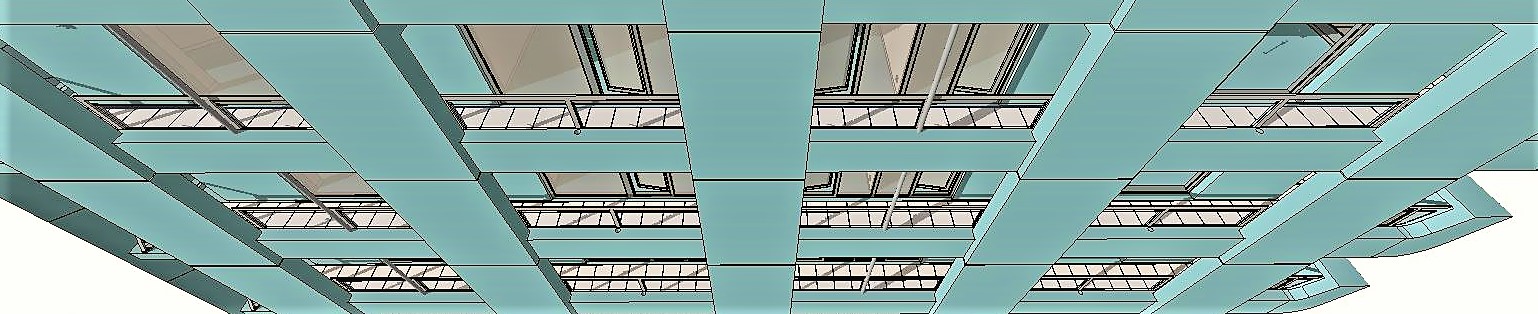
Who had the brilliant idea of plonking the conservatory on the top of the Barbican Arts Centre? It isn’t in the ‘Barbican Redevelopment 1959’ plan which contained the final designs for the Barbican. Well, whoever you were I raise a glass to you. It’s another of those eccentric elements which make the Barbican.
The Barbican Conservatory opened in 1984. It’s a tropical enclosure full of exotic flora, pools, walkways and fountains. It contains a variety of temperate and semi-tropical plants. You may recognise some of your house plants, but on a vast scale. (You will know how Alice felt when she drank the first bottle.) In 1986 they added an Arid House with cacti and one plant called ‘Fred’ which is the largest Carnegiea Gigantea in Europe, and was donated by the Mayor of Salt Lake City. (Arid House. What a fabulous name.) There used to be finches in an aviary and fish and terrapins in the ponds.
Apparently, instead of chemicals, they rely on ‘natural predators and pathogens’ to keep down pests. That sounds a bit alarming.
Position within the Barbican Centre
The conservatory is located at a high level within the Barbican Centre, occupying space around and above part of the theatre structure, including the fly tower. Its position reflects the layered construction of the building, in which different functions are arranged vertically as well as horizontally.
Design and purpose
The conservatory is enclosed in glass and contains a large collection of tropical and subtropical plants, together with water features and fish. It was introduced in part to soften the visual impact of the theatre’s fly tower, which would otherwise have formed a dominant element within the overall composition of the Centre.
By surrounding this structure with planting and glazing, the architects created a contrasting environment which both conceals and transforms its presence.
Character and atmosphere
The atmosphere within the conservatory differs markedly from that of the rest of the building. While much of the Barbican Centre is characterised by exposed concrete and complex internal routes, the conservatory provides light, openness, and a more informal setting.
The presence of plants, water, and natural light creates a space which contrasts with the more enclosed and structured areas below.
Access
The conservatory is not part of the main circulation routes through the Barbican Centre. It is reached deliberately rather than encountered in passing, and access is provided through specific routes within the building.
As a result, it has a distinct character from the more heavily used foyers and public areas.
Role for visitors
The conservatory has become an important feature of the Barbican Centre for visitors and is often regarded as one of its most visually appealing elements. Its location, however, means that it may not be immediately obvious to those unfamiliar with the layout.
As with other parts of the Barbican, finding it requires some understanding of the routes through the building.
Overall significance
The conservatory illustrates the broader approach of the Barbican project, in which different types of space are brought together within a single structure. It combines architectural, environmental, and recreational functions, contributing to the variety of experiences available within the Centre.
Although not directly related to the main performance or exhibition activities, it forms an important part of the overall character of the Barbican.